

Before we can talk about training your bat path with hitting PlyoCare® balls, we should answer this question: What is a good bat path?
The path the bat takes during the swing is one of the most important determinants of success in hitting for several reasons.
1. Efficiency of the bat-ball collision. Oftentimes, hitters waste bat speed by striking the baseball inefficiently. These glancing blows result in mishit batted balls with high spin rate and low exit velocity (think of a lazy fly ball or a line drive that “balloons” and doesn’t carry).

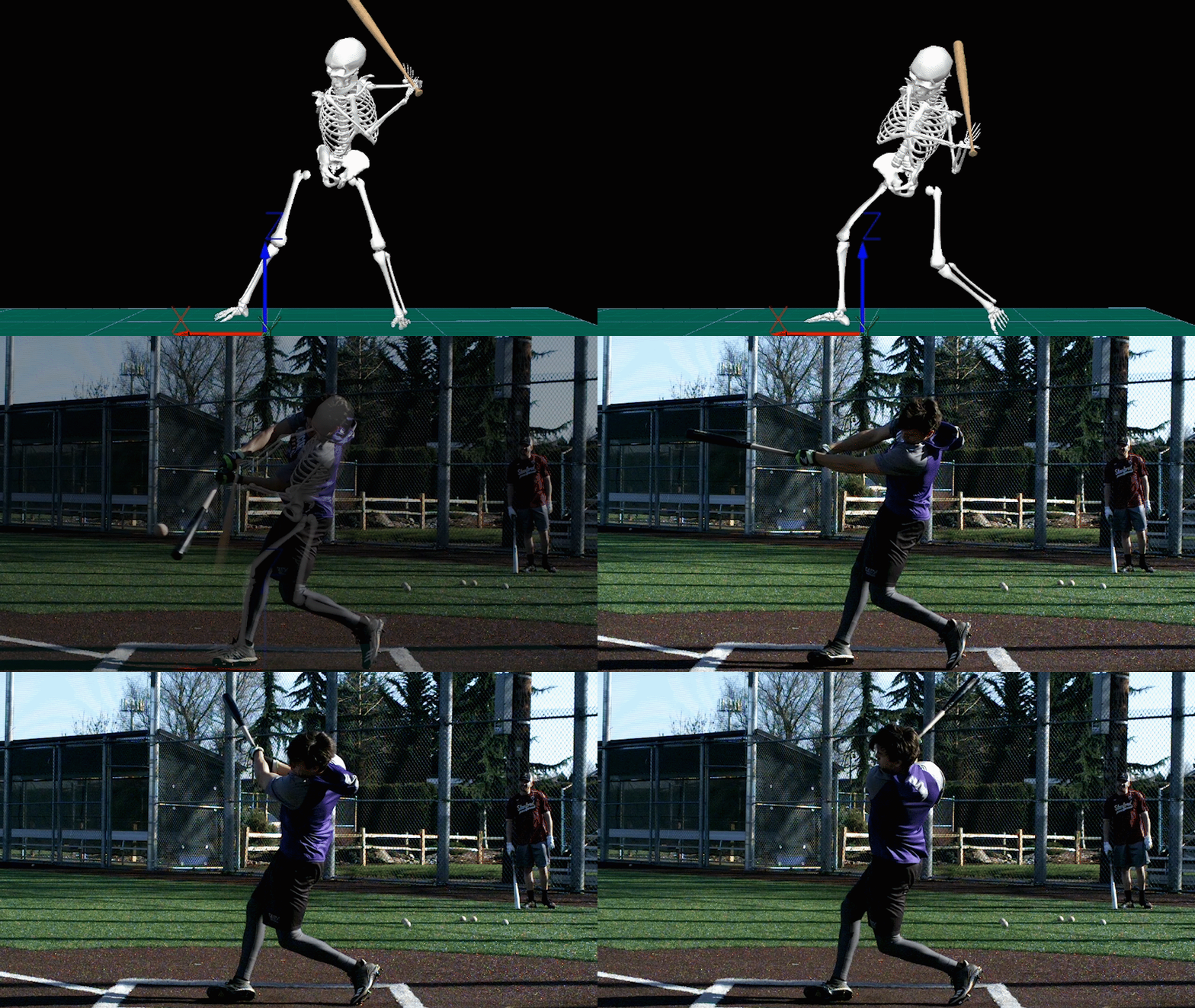
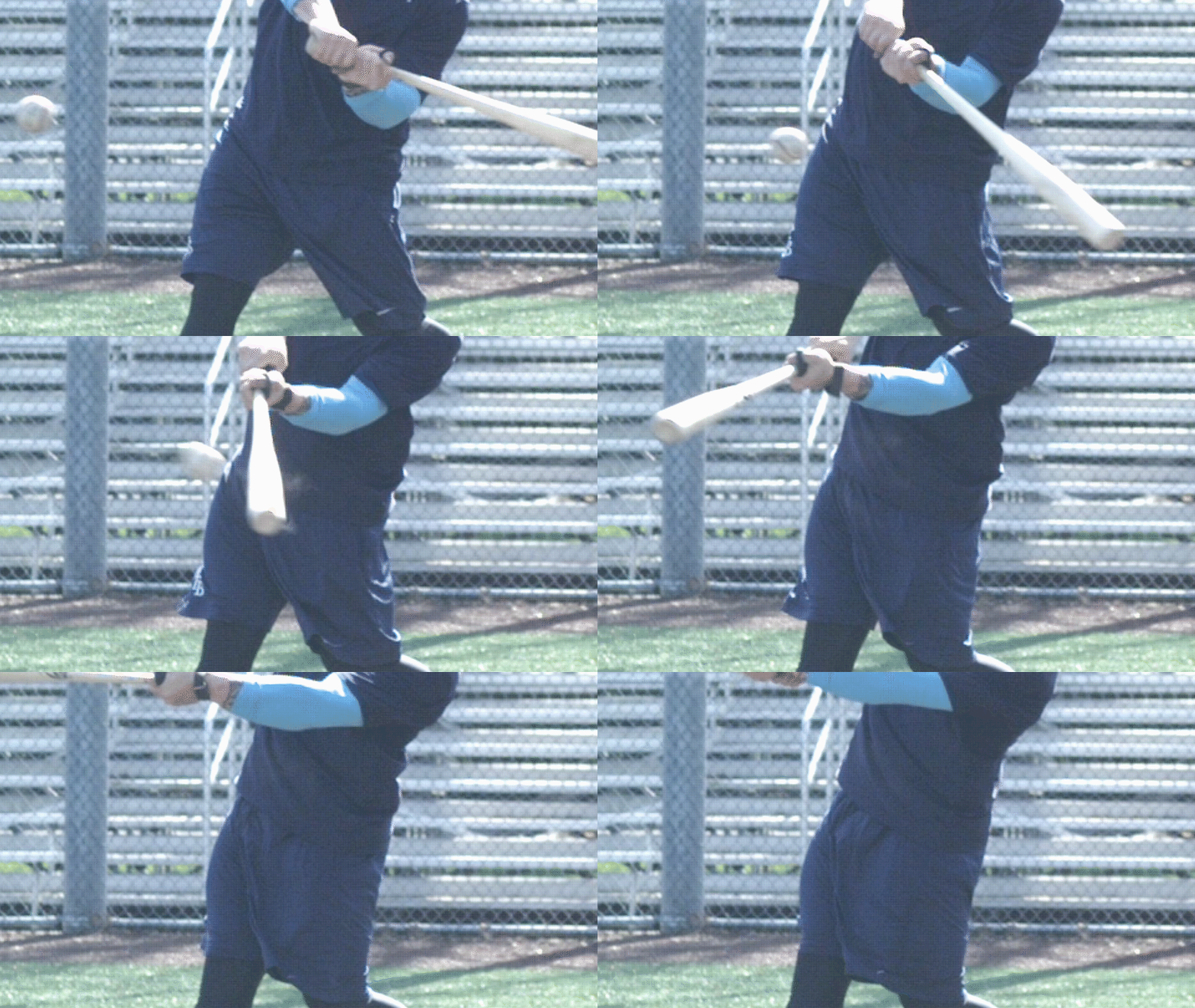
Example of being off-plane and on-plane with a hitting PlyoCare®
Few things are more frustrating for a hitter than getting a good pitch to hit, being on time, and not squaring up the baseball. This is often due to an improper path that creates a “clipping” bat-to-ball collision. A proper path will create “flush” contact, as we like to say, that results in piercing line drives and balls that carry when hit in the air.
Foundations of Hitting
30 modules teaching you everything we know about hitting and hitting mechanics.
A scout once told me this about a player: “When he hits balls, they STAY HIT.” What he was referencing was the carry on his batted balls as they flew into the outfield. This is due to flush contact resulting from a good bat path behind and through the baseball.

Behind and through: The barrel gets behind the incoming pitch and works through the incoming pitch plane vertically and horizontally.

Vertical Bat Path: Attack angle
Horizontal Bat Path: Swinging “down the line” and not cutting across the hitting zone with your swing. Here is a video example of both:

And for reference, the incoming pitch plane is not always the same so this requires adjustability in the bat path and swing direction.
Here's Scherzer and Sale, with the awesome new 3D vision pitch tool https://t.co/i8vI2ClE4c pic.twitter.com/iKov3ib33v
— Jason Ochart (@JasonOchart) March 10, 2018
Do you square up balls and feel like they should be carrying further? Chances are, your bat-ball collision is inefficient due to an improper bat path.
- Advanced: We can measure this using bat sensor data that is paired with incoming pitch angle data. We can also look at batted ball spin rate to reverse engineer the quality of contact. Generally, higher spin = more offset between bat and ball.
- Another advanced concept worth understanding is “barrel-to-path” and how it impacts the way batted balls are hit. A hit with an open barrel relative to the swing direction/path will result in a slicing impact. A hit with a closed barrel relative to the swing direction will result in a hook. This is impacted by your ability to sequence correctly, in particular, related to the timing of your wrists unhinging. The ability to learn how to unhinge/release your barrel on time for balls to all fields is another benefit of using hitting PlyoCare® balls.

Lots of grounders/top-spinners pullside = lifting up above the ball when early/outfront
2. The ability to adjust and hit “off-time.” One of the largest separators between good and great hitters is the ability to hit off-time. What do I mean by this? Almost all hitters can hit a ball decently hard if they are perfectly on time with the pitch. In the chaos of a real at-bat, however (especially against good pitching), the ability to hit when you are a tick early or late is what will determine your success throughout a whole season. Hitting is too hard, and pitchers are too good to expect to be perfectly on time every at-bat. Hitting is less about being good when you’re perfect and more about being good throughout a wider range of imperfect. This ability to hit off-time is largely created by a good bat path that is behind and through the baseball. This creates an “anti-fragile” path that will not chop down or lift up off the ball when the hitter is off-time.
- Advanced: A couple of years ago, before we used bat sensor technology at Driveline, we were using a hitter’s batted ball profile to reverse engineer their bat path and evaluate its integrity/antifragility. A lot can be learned by looking at the distribution of a hitter’s batted balls. Lots of flares oppo = underneath the ball when at a late/deep contact point. Lots of grounders/top-spinners pullside = lifting up above the ball when early/outfront. Now we can look at paired bat sensor data + spray angle data + launch angle data + point of contact data to really learn how well a hitter maintains their path.
What are Hitting PlyoCare® balls
Now that we’ve spent some time on the nature and benefits of a good bat path, what are hitting PlyoCare® balls, and how do they train a good bat path?
Hitting PlyoCare® balls are sand-filled rubber balls for hitting that we have at various weights and sizes. Our baseball-sized PlyoCare® balls come in 200g, 250g, 300g and 350g weights. The heavier the ball is, the more perfect you have to be to square it up. Our mini-PlyoCare® are smaller versions of our hitting PlyoCare® that are designed for training precision/barrel control.

A clipping or glancing blow will be far more exaggerated with a PlyoCare® ball than it will be with a baseball.
Hitting PlyoCare® balls are the best tool for getting real-time feedback on your bat-ball collision. A perfectly flushed swing will result in a hard-hit PlyoCare® ball that will carry and fly a long distance.
A perfect bat-ball collision will result in a hitting PlyoCare® with slight backspin. What makes this tool so effective is that the bat path and contact quality have to be near-perfect to get a good outcome.
- Advanced: PlyoCare® work is a good example of a “constraints-led approach” to hitting training. The quality of the feedback + the difficulty of the task create a learning-rich environment that allows the hitter to adjust and self-organize swing by swing. This, coupled with help from a coach, creates a very powerful training session. Furthermore, using PlyoCare® balls can train the bat path of the hitter without him or her even thinking about it, which is why they are so valuable to youth hitters in their training and pre-game warm-ups. As we’ve discussed before on our blog, it's the subconscious learning that happens as a result of a good training environment that often works best to train movement.
PlyoCare® balls are generally great for training bat path, and they are easy to work into your personal routine or your team’s pregame warm-up routine. One thing we know as coaches, however, is that every hitter is unique.
As a result, every hitter you work with has a unique bat path with its own flaws, so here are a handful of PlyoCare® ball drills designed to tackle specific bat path related swing flaws.
Bat Path PlyoCare® Drills
Here are some drills organized by Flaw, Cause, and Common Batted Ball Outcome
Flaw: Bad attack angle
Cause: too uphill or downhill
Common Outcome: clipped batted balls and a launch angle of hard-hit balls out of desired range)
- Underhand Flips with hitting PlyoCare® balls
-
Overhand Toss
Flaw: Lifting up off the ball out front
Cause: bat path breaks down by lifting up off the ball when contact points are out front
Common Outcome: lots of topspin/ground balls to pull side. Inability to lift ball in the air)
Flaw: Clipping the ball at deep/oppo contact points
Cause: not on plane deep in the swing arc
Common Outcome: balls deep in the hitting zone are often fouled off or sliced/flared to the opposite field with low exit velo and high spin)
Flaw: Inability to adjust to pitch height
Cause: inability to maintain a good path at various pitch heights
Common Outcome: batted ball outcomes very affected by pitch height, many ground balls on low pitches, fly balls on high pitches)
-
Height Ladder- mixing up the height of the incoming pitch
- Progression: low, middle, high, middle, low etc
- Random
Flaw: Inability to adjust to offspeed pitches
Cause: bat path is fragile and lacks the ability to stay through the pitch when timing isn't perfect
Common Outcome: high swing and miss or bad contact on offspeed pitches
Train at Driveline
Become the Hitter You Want To Be
Train at Driveline
- Athlete Questionnaire: Fill out with this link
- Email: support@drivelinebaseball.com
- Phone: 425-523-4030
By Jason Ochart, Director of Hitting
3 comments
In reply to Zane Shook: “What are the skinny bats they are swinging in the videos…”
Hi Zane- Those are a product we tested for a time called the Lightning Stick.
What are the skinny bats they are swinging in the videos
Super great important information, I am super really learning about thank you so much.
Leave a comment