

The goals of Driveline hitting are:
1) Create a data-driven program for developing hitters
2) Conduct research to help better understand hitting
Become the Hitter You Want to Be
Train at Driveline
My background
As a kinesiology student, I studied human movement. As I learned basic movement principles (in particular the fundamentals of biomechanics, motor learning and overall skill development) I came to a harsh realization. My understanding of the baseball swing was extremely inaccurate.
As a high school and college player, I fell victim to blindly accepting conventional wisdom regarding the swing (We will discuss some of these myths in later blogs). This angering realization has become more and more common amongst players, due to the advancements in technology and accessibility to video (YouTube launched my sophomore year of high school).
I spent my life trying to squish the bug, swing down, and stay closed (the list goes on) only to see slow-motion video and realize that big leaguers aren't doing any of that.

So, I decided to disregard all preconceived ideas regarding the swing and began to learn from video, research articles, and some of the great minds who are ahead of the curve. That approach sprung me into a successful stint as a college hitting coach and it eventually led me to Driveline.
Mission:
It is our passion to provide our athletes with the best possible program, not designed by mindless regurgitation of conventional wisdom, bias, and ego, but driven by science and data.
For who?
Driveline is designed for the committed player and coach who understands that improvement and refinement of their skill will come as the result of relentless hard work, not an overnight mechanical fix as advertised by some “gurus.”
How?
At Driveline, we will use any tools we deem useful towards developing our program and continuing to improve upon it.
Hit Trax

Hitters receive immediate feedback on exit velocity and launch angle
Diamond Kinetics

Hitters receive feedback on bat path, bat speed, time to impact, approach angle, among other things
Vision training

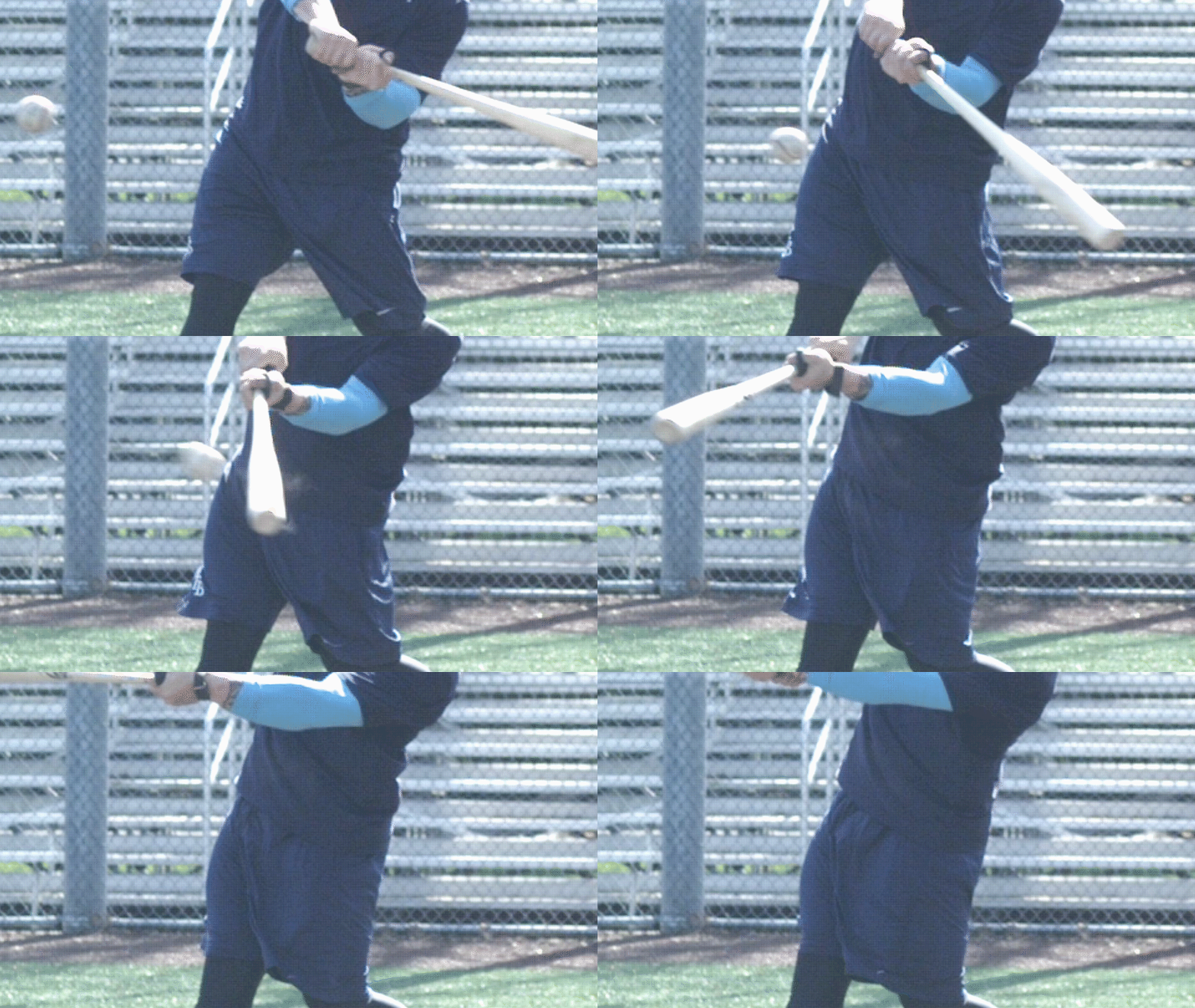
Edgertronic video
High resolution, high frame rate video for analysis
The goal is to see what is and isn't working, and make adaptations as we move forward. We have no interest in keeping our discoveries to ourselves. It will be shared for anyone interested in the baseball community. From a scientific perspective, we are aware that we do not know that much about hitters and their training methods, and we are okay with that. The goal of Driveline is to continue learning.
What to expect:
There will be frequent blog posts about our discoveries and our thoughts on relevant topics regarding hitting. We understand that hitting is a sensitive subject for some and conflicting ideologies are often met with irrational anger and contempt. We have no interest in upsetting anyone, but understand that's inevitable. You can take or leave our material, it's no sweat to us. We are loyal to the data.
If you have any thoughts or ideas, feel free to comment below. We are very excited to get going and we appreciate your interest.
Foundations of Hitting
30 modules teaching you everything we know about hitting and hitting mechanics.
Train at Driveline
Interested in training with us? Both in-gym and remote options are available!
- Athlete Questionnaire: Fill out with this link
- Email: support@drivelinebaseball.com
- Phone: 425-523-4030
17 comments
In reply to Doug jones: “Who’s your favorite uncle?…”
I think you will find that on a perfectly timed swing on a pitch on the inner half of the plate that the hands and wrists do nothing but go along for the ride. I believe that is why most MLB hitters tape their wrists. I think you can have a high level swing with your hands and wrists in casts and not lose an MPH on your bat speed. How about putting some casts on Jack the Gigantor and testing it out.
Actually your arms and arm flexion only help you for timing issues. In actuality you could put casts over the elbows and not lose any bat speed or power on a perfectly timed inside pitch. I will even come up from Portland and get casted up. Then we would really see the end of the Kinetic chain on a high level swing.
In reply to Doug jones: “Who’s your favorite uncle?…”
You know the answer to that one
Your going nowhere but up Jason! It makes my day to see you writing on this platform! Listen to his words people.. you might just learn a thing or two!
In reply to Jason Ochart: “Dominik, Thanks for your comments. Typically, increasing a hitter’s hip rotation…”
Jason I get that the rotation pulls the hands but the question is whether the hips directly pull on the shoulders or whether they merely stretch the trunk muscles.
I want to know why pitchers basically land completely open (so that their hip rotation basically does nothing to DIRECTLY accelerate the shoulders but merely create a stretch while hitters usually land only a little open but while they have some separation they still have most of the hip turn (probably three quarters of it) after heel plant in unison with the shoulders. I hopefully get my message across, my English is not really good.
also second question is whether you think there is an active barrel turn. there are several theories on how the Bat is accelerated. first there is the double pendulum theory basically saying that if you have a circular hand path the centrifugal force causes the Bat to fly out (Nyman)
then there is the crack the whip theory that says you decelerate the hands which causes the Bat to whip forward (Dr Yeager).
and finally a lot on hitting twitter believe that the barrel is turned around the hands and rearward with the elbow slotting and also sometimes rear forearm supination (I think Tewksbary believes that).
Who’s your favorite uncle?
Leave a comment